2024: Onwards

Photo by Pixabay on Pexels.com

Happy 2024 to you all – may this year be one of health and happiness for you.

Thank you so much for still following my writing journey. and for your unwavering support. If I’m quiet on here it means that things are happening behind the scenes and I just have to wait and not say anything until the final decision has been made – and throughout 2023, that decision by the publishers who took the time to read my manuscript (thank you so much) was unfortunately a no. The publishing industry moves so slowly, and I’m finding it hard to find a publisher who will suit and embrace my niche.

However, I will. never give up, and I’m excited to say that my manuscript is currently being read by the fiction and non-fiction editor of one of the Big 5 publishing companies. No news is good news, so far. If it is another no, then I’ll have to reassess my options and keep going. In the meantime, I’m working on my next novel which is also historical fiction. At the moment I’m knee-deep in research, which is lasting months, even though I have already written the contemporary timeline. I’m yet to have a title.

Hopefully I can check in again soon with some more positive news regarding my publishing journey. I hope you are digging your way through your TBR piles and thoroughly enjoying the joy that is reading.

Rachael x

Where I’m at.

Hello friends 🙂

It’s been quite a ride this year. Several rejections from publishers, large and small, some which hurt deeply.But that’s the journey of a writer and what I signed up for. ‘The Sound of Crimson’ is currently with another publishing house so fingers crossed!

Writing this novel taught me so much. The dark depths of grief and how exquisitely painful they are. But the beauty that can arise from such depths. It’s a rotten way to learn, but I am determined to take something away from the pain if I can. It’s made me appreciate those I love so very, very much, and made me acutely aware of how fragile life is. Writing this novel encapulates all of this and so much more.

I hope I am able to one day share my journey – Eszti’s journey – with you all.

xx

To Be A Woman

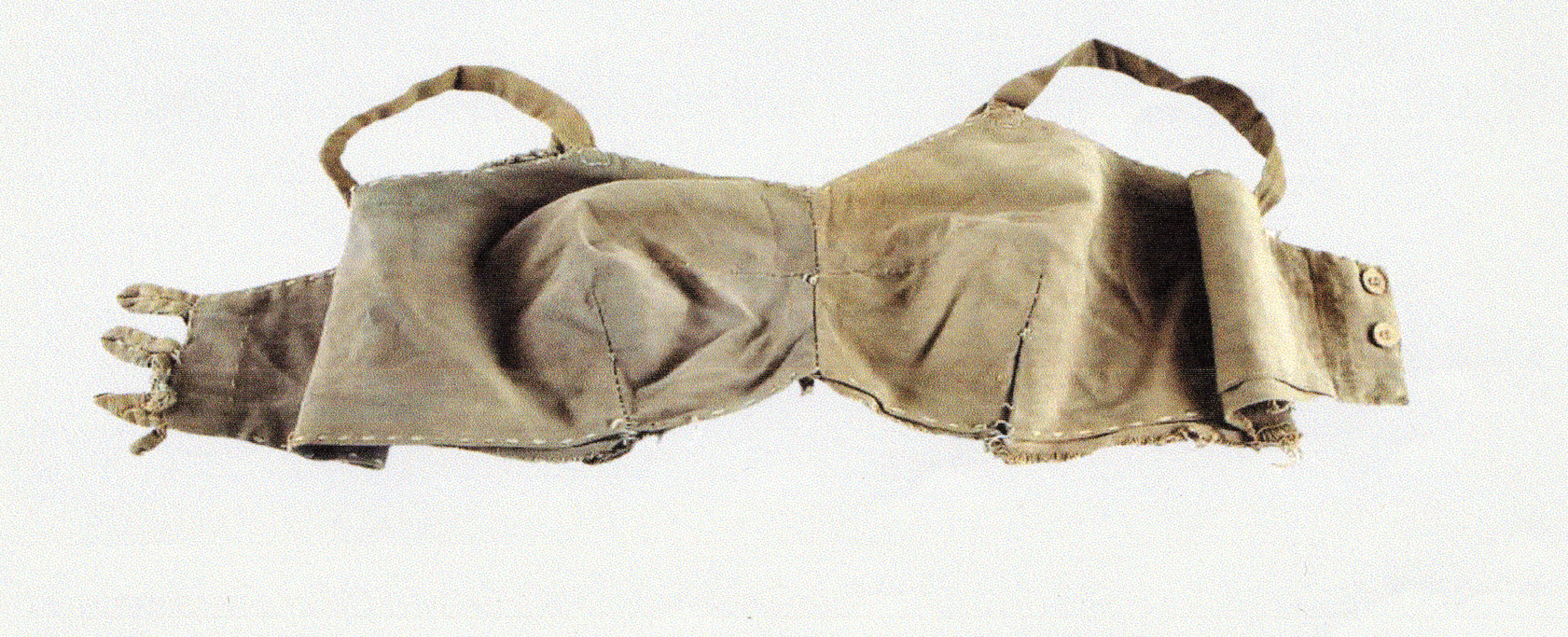
A bra made by Lina in the Stutthof concentration camp: Image copyright Yad Vashem.

Yad Vashem, The World Holocaust Remembrance Center in Israel, held an exhibition several years ago titled Spots of Light: To be a Woman in the Holocaust. It was curated by Yehudit Inbar and exhibited at Yad Vashem. In the introduction to the Spots of Light exhibition, Yad Vashem states:

Women in the Holocaust applied their minds to a place that deprived them of their minds; and brought strength to a place where they were denied their strength. In a place where the very light was wrestled from women and their families, faced their deaths with fortitude and invested every additional moment of life with meaning. It is these women’s voices that we wish to sound and whose stories we wish to tell.”

Spots of Light: To be a Woman in the Holocaust is a fascinating and extremely moving account of the experience of women in the Shoah. The exhibition focuses on the multiple aspects and roles of Jewish women in many countries, not necessarily in concentration camps. The areas of focus are: LOVE, MOTHERHOOD, CARING FOR OTHERS, WOMANHOOD, RESISTANCE AND RESCUE, FRIENDSHIP, FAITH, FOOD, and ART.

I was particularly moved and inspired by the above image and story of the handmade brassiere under the category of womanhood. Yad Vashem states that Lina Beresin, born in Lithuania, was deported to the Stutthof concentration camp where Lina made the bra for herself. Her husband was sent to Dachau and murdered. Lina and her sisters survived. She immigrated to Mexico.

In Lina’s own words:

“They dressed us in prisoners’ outfits. As a professional seamstress, I began to dream about how to make myself a bra and what materials I would use. I removed the lining from the the sleeves [of men’s jackets] and now had some fabric. From my men’s shirt I removed three buttons. A woman who found a needle in her jacket gave it to me in return for a full day’s food ration. I unraveled thread from the ribbon around the blanket. I found a broken window and removed a shard of glass from it. I lay down on the ground with my fabric and the shard of glass and I cut my prized item. Then I sewed it. I wore the bra for seven months until the liberation.”

(Lina Beresin, copyright Yad Vashem.)

A spot of light, indeed.

The Crimson Thread and the Hungerford Award

‘The Crimson Thread’ was the title of the creative artefact in my Master of Arts (Writing and Literature) thesis. I have extended it to novel-length and It has just been longlisted in the Hungerford Award for an unpublished manuscript which is THRILLING!!!! The winner of the Hungerford Award, announced on October 20th, receives $15,000 and a publishing contract with Fremantle Press. My manuscript draws from my recent experience of deep grief and the feeling of everlasting love that can arise from such darkness. My thesis focused on bearing witness to traumatic experiences in the literary form, and my particular work was the first to be addressed in both the academic and creative form. This audiovisual video is a summary of the emotions and themes of the creative artefact and the resulting novel-length manuscript. Families of Holocaust survivors were consulted during the writing of this thesis.

** Content warning: some images may be confronting.

November 2020 Update!

Well, what a shocker of a late update – the last was in February when I was in England – just before Covid-19 hit Australia, and we scraped back in with only a few days to spare before the first lockdown. So much has happened since then.

Perhaps the most amazing (well, yes, definitely THE most amazing!) was the shortlisting of my historical fiction manuscript, ‘Roses of Budapest’, in the HarperCollins Banjo Prize for an unpublished manuscript. I was a runner up and extend HUGE CONGRATS to Dinuka McKenzie, the winner of the 2020 Banjo Prize, who as a result won a publishing contract from HarperCollins Australia with her crime manuscript ‘Flood Debris’. I can’t wait to read her novel in 2021! You can find the HarperCollins Banjo shortlisting press release below:

https://www.harpercollins.com.au/press-room/harpercollins-publishers-announces-shortlist-for-the-2020-banjo-prize/

I’m continuing to polish ‘Roses of Budapest’, an untold story about a strong young Jewish woman in Nazi-occupied Hungary in WW2. I have SO much passion for this story, and I hope it finds a publishing home soon. Like my protagonist, Matild, I will never give up. 🙂

On the uni front, I am on track to finish my Masters in Writing and Literature thesis, and degree, in July 2021. Again, a story of war, strong women, love, but this time, a strong focus on the reconciliation of trauma – so a lot of literary trauma theory and research. Just as with my novel, I am totally in love with my thesis and have the most amazing and supportive supervisor.

I have another exciting opportunity with ‘Roses of Budapest’ soon, and if anything eventuates I will be sure to let you know.

I don’t need to reiterate how hard 2020 has been for so many people, all over the world. Let’s hope 2021 is a much better, healthier and happier year for all. Together, we can do this. As Emily Dickinson wrote:

“Hope” is the thing with feathers –
That perches in the soul –
And sings the tune without the words –
And never stops – at all –

And sweetest – in the Gale is heard –
And sore must be the storm –
That could abash the little Bird
That kept so many warm –

I’ve heard it in the chillest land –
And on the strangest Sea –
Yet – never – in Extremity,
It asked a crumb – of me.

Thank you so much for your wonderful support,
and take gentle care.

xx


Love in a little village coffee shop

It is an early, chilly Tuesday morning in the middle of England. We rush into a little coffee shop. It is in an old village. Quaint. It is cosy inside the shop, wicker chairs and rickety tables, bright couches with cushions. We settle down and my family walk over to the counter to order espressos and crossaints. I take off my leopard print fluffy coat and sink into the leather couch.

A man and woman – in their late eighties? early nineties? – shuffle towards one of the tables. The gentleman guides the woman, I’m sure it is his wife, into an old chair. He pulls the chair out, gently takes off her coat, and almost delicately places her in the chair. She is tiny, bird-like, and nearly disappears. She is wearing a beautiful green scarf, which her husband gently unwinds from her neck revealing a stunning pearl necklace. I understand he probably dressed her this morning. How she would have wanted to be dressed. She thumps the table, yells at the little girl near her to shut up. He strokes her forehead.

He shuffles to the chair opposite and places her scarf in a worn plastic bag, then removes two off-white napkins. One he gently puts on his wife’s lap, the other on her chest. She mumbles incoherently and he replies calmly, their wrinkly hands intertwined firmly on her lap.

The waitress brings two cups of tea and two scones over. She smiles, uses their names. I can tell this is a daily outing. He puts two sugars in her tea, and then she puts salt in his. He smiles, pushes his cup away a little. She looks at him lovingly. ‘Drink up, love,’ he encourages her. She puts her delicate hands around her cup and manages a few sips with only a minor spill. He wipes her face and she tries to cut up his scone with a teaspoon. He helps her. With the teaspoon.

I have never felt so warm inside. I have never seen such lifelong unconditional love and companionship that thrives despite dementia and old age. These beautiful souls have just shown me true humanity.

I was blessed to walk into this little village coffee shop today.


Dancing Large

woman standing by one foot and holding flare stick near trees

It has been nearly fifty years since I have last been in his arms, since I have glimpsed his deep brown eyes, run my fingers through his dark hair. I am not going to dance small with my lover tonight. I slip my favourite red dancing frock over my head, fitted at the waist and flaring out just below my knees. As he twirls me around the Embassy Ballroom my skirt will twirl like a bright spinning umbrella. I sit at my maple bureau and try to recognise myself. I come back into myself. I am fifty years younger.

I carefully powder my face, then place back the powder puff; rub creamy pink rouge into my cheeks. The red lipstick glides effortlessly across my lips. I have not forgotten how to do this, how to be a young woman. Finally, I pin on the pearl earrings he gave me when I turned twenty-five and buckle my dancing shoes. I stand and look at my reflection. I am me again.

As I enter the living room, he is reclining in his favourite armchair, waiting for me. A stuffed pipe in one hand, the air heavy with his smoke like the calmness of a hearth at mid-winter. As he sees me, he drops his pipe. Time does not stand still. Time has stood still for far too long, for half a century. Now time is alive again. He rises and takes me into his gentle arms; I see the eyes of my husband, eyes I have never forgotten, and I stroke my fingers through his dark hair. He places a soft, small kiss on the corner of my mouth and we rest close together once again. He whispers into my hair, asks me if I am ready to go out dancing with him.

I am ready. I am more than ready. I have been ready to dance with my husband since March 1970; yesterday it was March 2019. We will not dance small tonight. After nearly fifty years apart, nothing will ever make me dance small with my husband again. We will dance loud, big, wide, flamboyant. We will sing, laugh, talk, trip over each other’s feet and he will catch me when I stumble.

No, I will never dance small again.


Deakin University, and a lesson from a Holocaust Survivor

2018 has been an amazing year! Rocky at times, but utterly amazing right now. I’m excited to have been accepted into a postgraduate course in creative writing at Deakin University for 2019! It will be part-time over two years, and I can’t wait.

After my manuscript assessment in September, I decided to really rip my book apart and rebuild it from scratch. It was okay, but it wasn’t the story I really wanted to tell. It wasn’t the story that was whispering to me furiously at 3 AM, refusing to stay silent. I didn’t know that until I’d written it, though. So even though I’m a little frustrated to see so many thousands of words going down the drain, it’s bringing me closer to the true core of my real story.

I’m digging deeper, going in layer after layer, trying to give the legacies of the stories of the Holocaust survivors and victims the honour they deserve. And because it’s such an important legacy, I’m prepared to research harder, think harder, work harder, feel harder.

I am totally immersing myself in my character. One powerful thing I did recently was to watch the video testimony of a Hungarian Jewish underground resistance fighter, Judit, which was recorded as part of the University of Southern California Shoah Testimony Collection. I cried so many times throughout the two hour video, and can only hope my character is as brave, dignified, and courageous as Judit was. 

I am learning so much every day. At times my heart absolutely breaks at the horror of humanity, at times it sings with the beauty of how kind and strong some people were in times of terror.

Judit’s message to the world was: “Never Again let it be repeated.”

Never Again.

How to Title Your Book

Very helpful! My manuscript title has changed each draft!

taraeast88's avatar

Some authors find titling their book easy. Others struggle with the process. I’m definitely an “other.” Recently, I went through the surprisingly drawn out process of coming up with a title for my manuscript. Over the past four years, my manuscript has changed names three times; a book syndrome known as, Ye Old Identity Crisis. For two years it was called, Ghost Book, because that was literally the best I could do. Later, I realised all my characters were Haunted by mistakes made in their respective pasts. Get it? Haunted + ghosts = title that works on two levels? Yeah okay, I know, I know. You don’t have to tell me twice. That’s why I changed it.

In brainstorming a new title, I came up with the following method. Maybe it will be help for you too.

  1. Themes, keywords and symbols

    I know this step may seem obvious, but have…

View original post 855 more words

Tim Winton – ‘Tender Hearts, Sons of Brutes’

pexels-photo-340876.png

I was lucky enough to hear Tim Winton speak about his new novel, The Shepherd’s Hut, at the Perth Festival writers week on Saturday night at UWA. It was the world premiere of Winton talking about his new book, to be released on March 12th 2018. We were given a  handout from Winton titled ‘Tender Hearts, Sons of Brutes. Tim Winton on lost boys and toxic masculinity’, and the following passage is from the inside page.

” ‘For the first time in me life I know what I want and have what it takes to get me there. If you never experienced that I feel sorry for you. But it wasn’t always like this. I been through fire to get here. So be happy for me. And for fucksake don’t get in my way.’

Jaxie Clackton is on a journey to adulthood. But he’s doing it all without a map. And in more ways than one. Like many young men, he’s over-armed and desperately underprepared. And the reason for that is no mystery.

Everything Jaxie’s learnt about being a man is corrupt. Not just defective, not simply incomplete or inadequate, but dangerously, poisonously wrong. Because the men in his life, the only people upon whom he’s been able to model himself, are brutes. They trade in force. They arm themselves against imagination and empathy and contemplation. Every man in Jaxie’s life up to this point has been a fortress. For these men, relationships are equations. Problems requiring mastery. In this airless universe there are no conversations, only declarations and fraught silences. Then men in Jaxie’s life are emotional infants.

I think we forget or simply don’t notice the ways in which men, too, are shackled by misogyny. It narrows their lives. Distorts them. And that sort of damage radiates; it travels, just as trauma is embedded and travels through families. Misogyny, like racism, is one of the great engines of intergenerational trauma.

                                                                                                 – Tim Winton”

The session was thought provoking, blunt, poignant, and full of swear words (for which Winton apologised to his mother in the audience – he told her Jaxie made him say it!)  The Shepherd’s Hut will be a challenging and confronting read, least due to Jaxie’s limited vocab, and Winton says that he expects some readers to dis-engage and not follow Jaxie’s journey through to the end as it is…very confronting. Brutal. Personally, I’m looking forward to the challenge.

Winton said he didn’t set out to write about masculinity or misogyny, he was just following the voice of a teenage boy in his head throughout the first draft (who swore a lot.)  It was when he had finished, and he had some perspective on what he had written, that he hoped it would spark awareness and further important conversations about boys and young men, and their relationship with themselves and with society. And what we, as a society, can do to help.

It was amazing to be a mere few metres away from this legendary writer for over an hour, his voice interspersed with music and pictures of boys and young men and the Western Australian landscape. He said he is just a bloke who loves a good surf, and being a husband, father, and grandfather. A son, brother, neighbour and a mate.

That night I walked away with the upmost respect and admiration for Tim Winton.  If the desire of the writer is to connect with readers, this writer connected with a whole theatre full of people through not only his literary prowess, but through his own, and his passion for, humanity.